
RCC Staircase Section Design with Reinforcement Details | A Comprehensive Guide for a 3’-3” Wide Staircase
Introduction
This document presents a well-designed staircase—specifically tailored for residential buildings—that prioritizes both functionality and safety. This guide provides a detailed overview of the RCC staircase section and plan, encompassing its dimensions, reinforcement specifications, and the standard design methodologies employed in its construction.
Whether you are a Civil Engineer, an Architect, or an AutoCAD Designer, these details will assist you in understanding how to prepare RCC Staircase Section Design drawings for both site execution and regulatory approval.
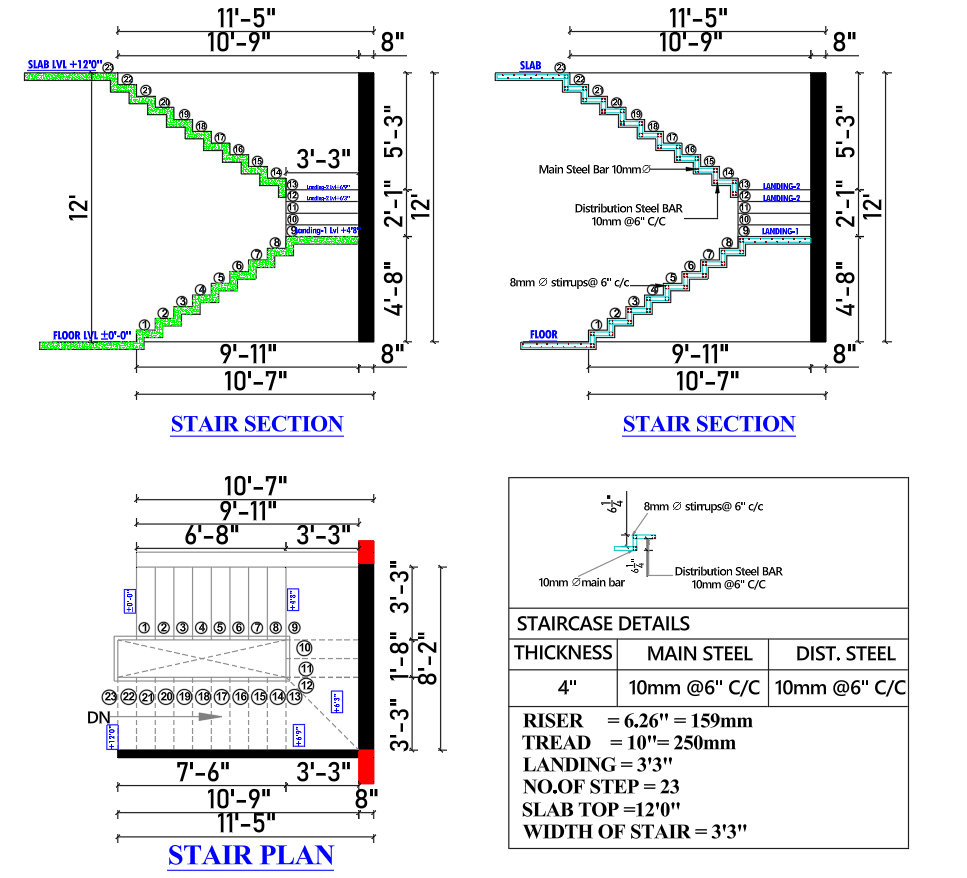
Staircase Design Overview
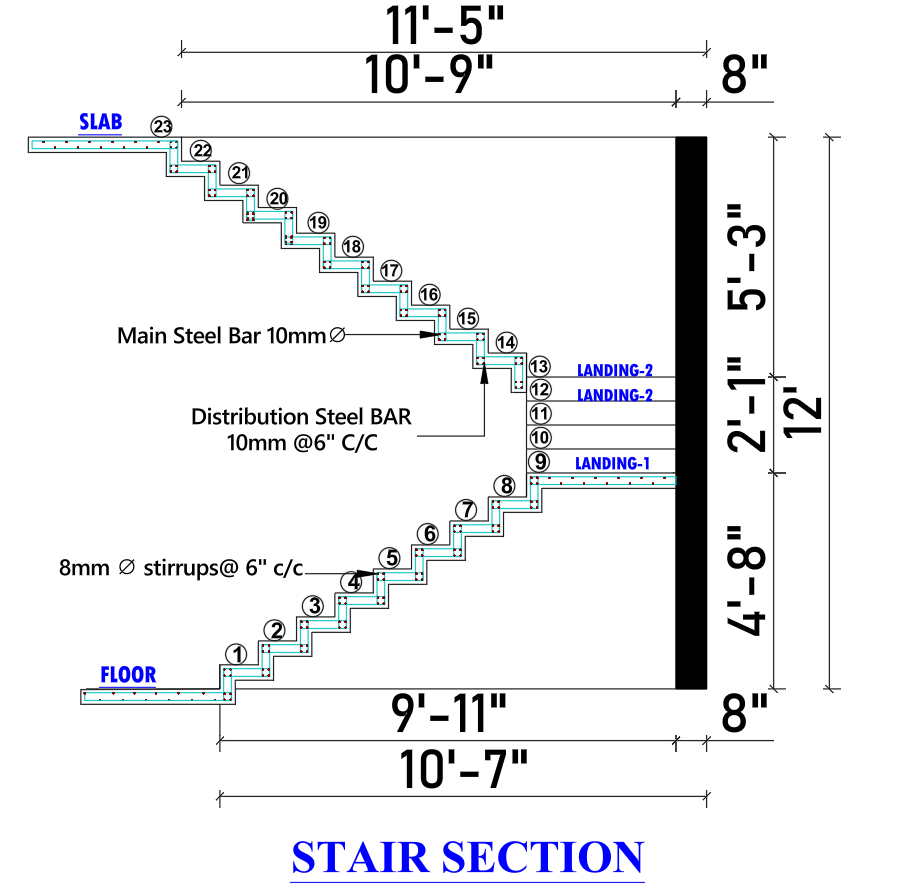
The RCC Staircase Section Design depicted in this drawing is a ‘Dog-legged’ RCC Staircase Section Design, featuring a mid-landing. It utilizes space efficiently and is commonly employed in residential buildings.
Key Features:
- Staircase Type: Dog-legged Staircase
- Total Steps: 23
- Staircase Width: 3’-3” (Approx. 1000 mm)
- Floor-to-Floor Height: 10’-7”
- Mid-Landing: Provided
Staircase Dimensions
1. Riser and Tread
- Riser Height: 6.26” (≈159 mm)
- Tread Depth: 10” (≈250 mm)
👉 This combination adheres to standard ergonomic design principles:
- Making it comfortable to walk on
- And safe for home use
2. Staircase Width
Staircase Width: 3’-3”
This width is ideal for:
- This staircase is utilized in small to medium-sized residential buildings.
- It plays a significant role in facilitating the easy movement of people and furniture.
3. Landing Details
Landing Width: 3’-3”
The landing provides:
- A resting space
- The facility to change direction
- Structural support
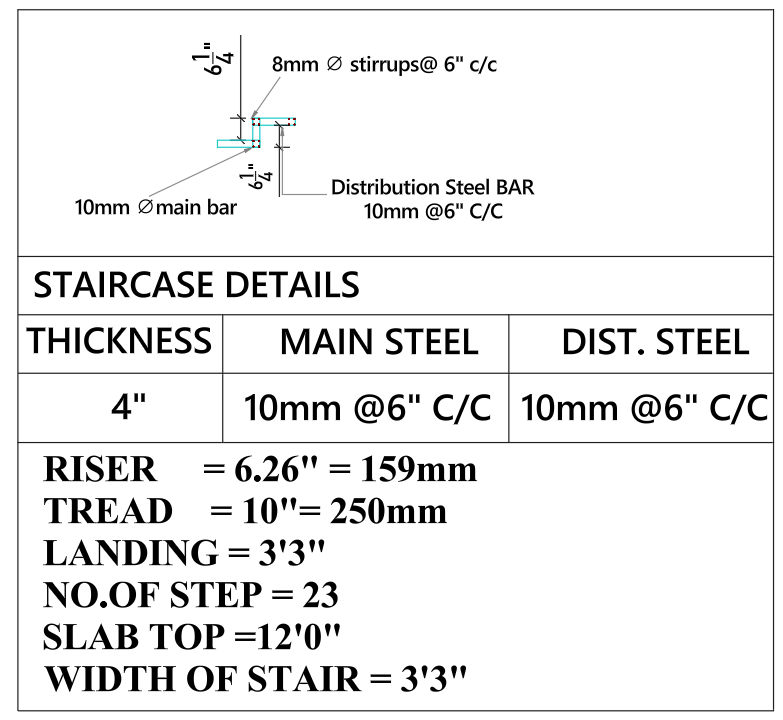
Staircase Structural Details (RCC)
1. Waist Slab Thickness
- Thickness: 4 inches
This ensures:
- Adequate strength
- Transfer of load to beams/walls
2. Reinforcement Details
Main Steel
- 10 mm diameter bars
- Spacing: 6 inches c/c
Distribution Steel
- 10 mm diameter bars
- Spacing: 6 inches c/c
Stirrups
- 8 mm diameter
- Spacing: 6 inches c/c
3. Reinforcement Arrangement
- Main bars run along the slope of the staircase.
- Distribution bars are placed perpendicularly.
- Proper anchorage is provided at the landing.
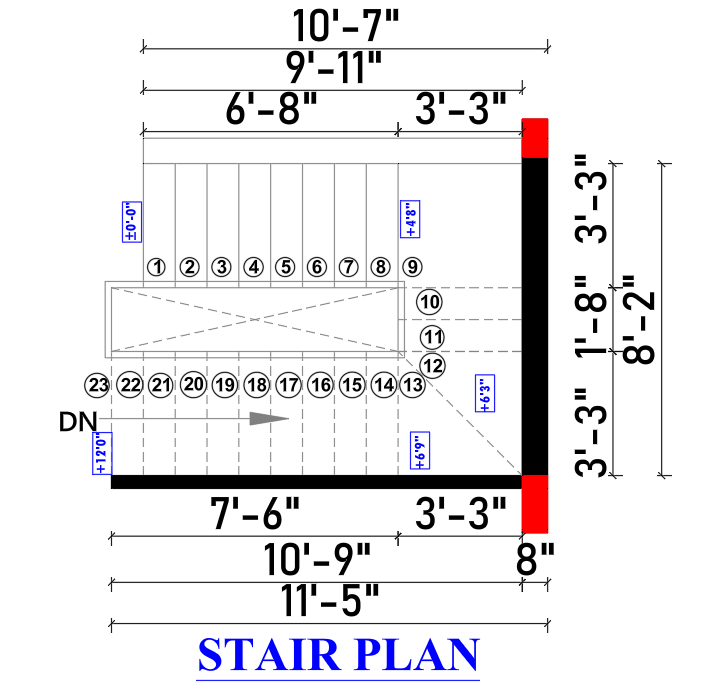
Staircase Plan Explanation
This plan illustrates the following elements:
- Direction of travel (Up/Down)
- Stair numbering (1 to 23)
- Landing area
- Stair width and clearance space
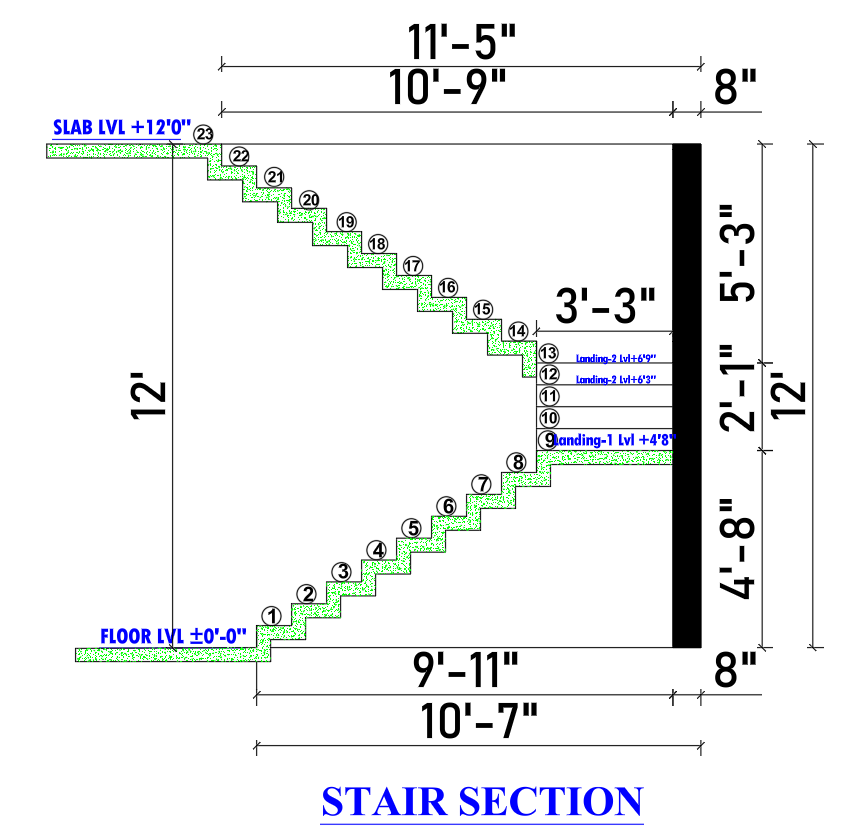
Important Observations Regarding the Plan
- Total Horizontal Length: Approximately 10’-7”
- Adequate width has been provided for movement
- Proper alignment with the walls
Important Observations Regarding the Plan
The section drawing illustrates the following elements:
- The profile of the riser and tread
- The thickness of the waist slab
- The placement of reinforcement
- The connection of the landing
Why is a Section Drawing Important?
- It facilitates construction work on-site.
- It depicts the structural behavior.
- It ensures accurate slopes and dimensions.
Design Standards and Rules
General Rules for Staircase Design
- Riser + Tread ≈ 17” to 18”
- Ideal Riser: 150–170 mm
- Ideal Tread: 250–300 mm
✔ Your design must strictly adhere to these standards.
Advantages of This Staircase Design
- Space-saving layout
- Robust RCC structure
- Comfortable stair proportions
- Easy to construct
- Suitable for residential buildings
Common Mistakes to Avoid
- Unequal riser height
- Insufficient landing width
- Improper reinforcement placement
- Too steep or too flat stairs
Conclusion
This RCC Staircase Section Design is a perfect example of a practical and structurally sound RCC staircase. With proper dimensions, reinforcement, and layout, it ensures safety, durability, and user comfort.
If you’re preparing AutoCAD drawings or site execution plans, this type of detailed stair section is essential for accuracy and approval.
The standard riser height ranges between 150 mm to 170 mm.
The ideal tread size is around 250 mm to 300 mm.
This is a dog-legged staircase commonly used in residential buildings.
Minimum width is 3 feet, but 3’-3” is more comfortable.
Reinforcement ensures strength, durability, and load-bearing capacity.