
Building Regulations for House Planning in India: Setbacks, FAR, Height & Open Space Explained
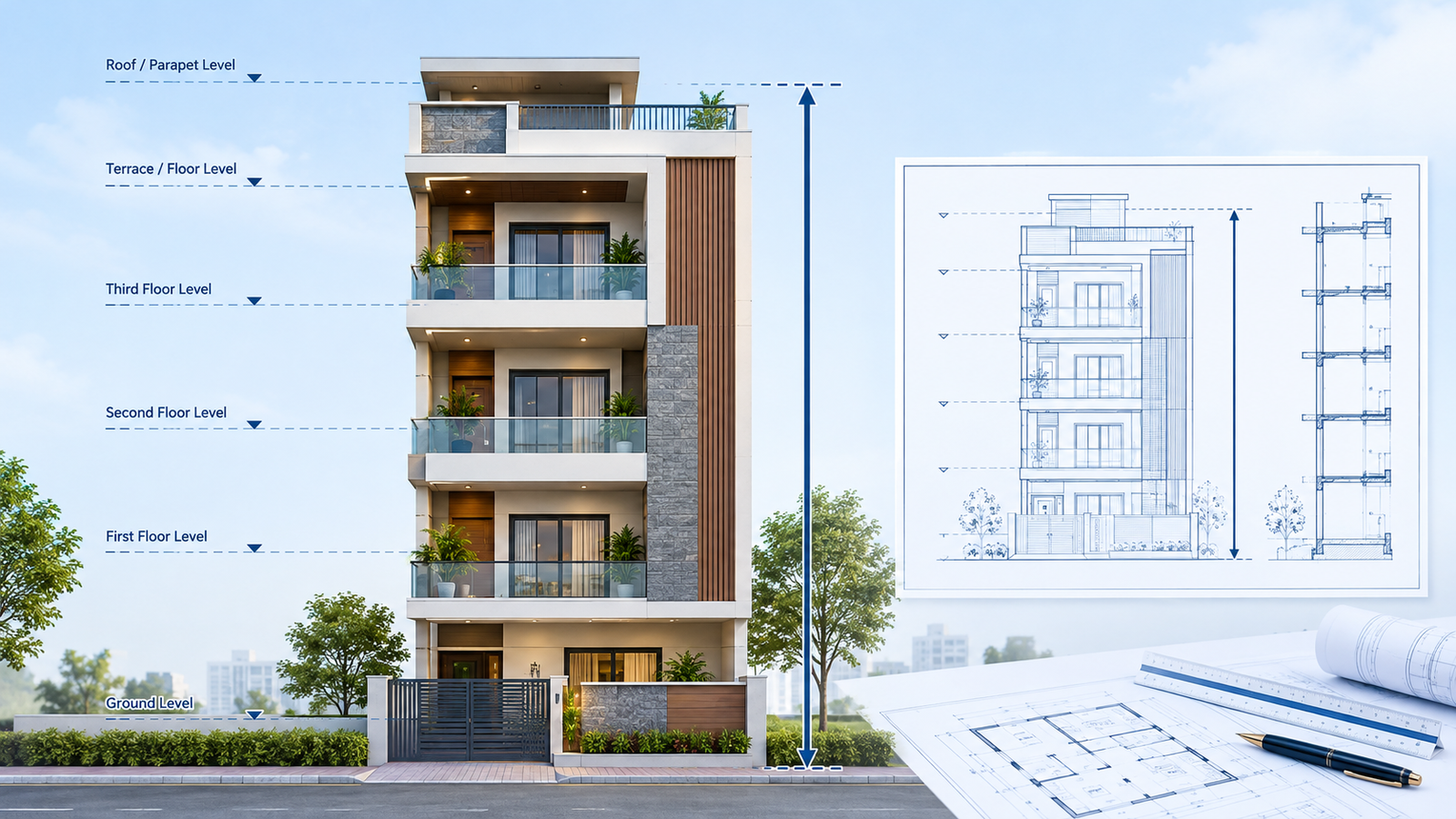
Planning a house is not only about deciding the number of bedrooms, kitchen size, staircase location, or front elevation. Before finalizing a residential design, it is equally important to understand the building regulations that control how much and where you can construct on your plot.
A house plan may look attractive on paper, but it still needs to fit within the development rules applicable to the particular property. These rules can affect the building footprint, open spaces, setbacks, floor area, height, parking, access, ventilation, and other planning requirements.
Building regulations are not exactly the same throughout India. The applicable requirements depend on the location, local authority, plot characteristics, road width, land-use zone, building type, and other project-specific conditions.
This guide explains the major planning rules that commonly influence a residential house design and shows why they should be considered before preparing the final architectural plan.
What Are Building Regulations?
Building regulations are requirements used to control the planning and development of buildings.
For a residential project, they can determine things such as:
- How much of the plot can be covered by construction
- How much open space must remain around the building
- How much total floor area can be developed
- How high the building can be
- Where parking should be provided
- How the building should relate to the road
- Whether adequate light and ventilation are available
- Whether special safety provisions are required
The exact values are decided by the relevant local authority and applicable regulations.
Therefore, a dimension that is acceptable on one plot may not necessarily be permitted on another plot in a different location.
Why Should Building Rules Be Checked Before Designing a House?
Building rules should be checked at the beginning of the planning stage rather than after the house plan has already been completed.
For example, imagine a homeowner plans a large living room, three bedrooms, a staircase and a covered parking area. After the drawing is completed, it is discovered that the required front setback leaves less usable building width than expected.
The plan then has to be redesigned.
Checking regulations first helps avoid this type of situation.
A preliminary regulatory check can help the designer understand:
- The approximate buildable portion of the site
- Required setbacks
- Permitted ground coverage
- Applicable FAR or FSI
- Building height limitations
- Parking requirements
- Road and access conditions
- Special restrictions applicable to the property
This creates a more realistic starting point for architectural planning.
Checking building regulations before finalizing a house design can help prevent avoidable changes during the approval stage. To understand the complete procedure, read our guide to the building plan approval process in India.
1. Plot Area and Buildable Area
Plot area is one of the first pieces of information required when planning a building.
However, the entire plot area does not automatically become construction area.
Part of the site may need to remain open because of setbacks, access requirements, parking, landscaping, drainage, or other local conditions.
For example, a plot may have sufficient total area for a particular house size, but the usable building footprint may be reduced because open spaces have to be maintained around the proposed structure.
This is why designers should distinguish between:
Plot Area:
The total area enclosed within the property boundaries.
Building Footprint:
The portion of the site occupied by the building at a particular level.
Total Floor Area:
The combined floor area considered under the applicable development regulations.
Understanding these three concepts prevents unrealistic planning assumptions.
2. Setback Requirements
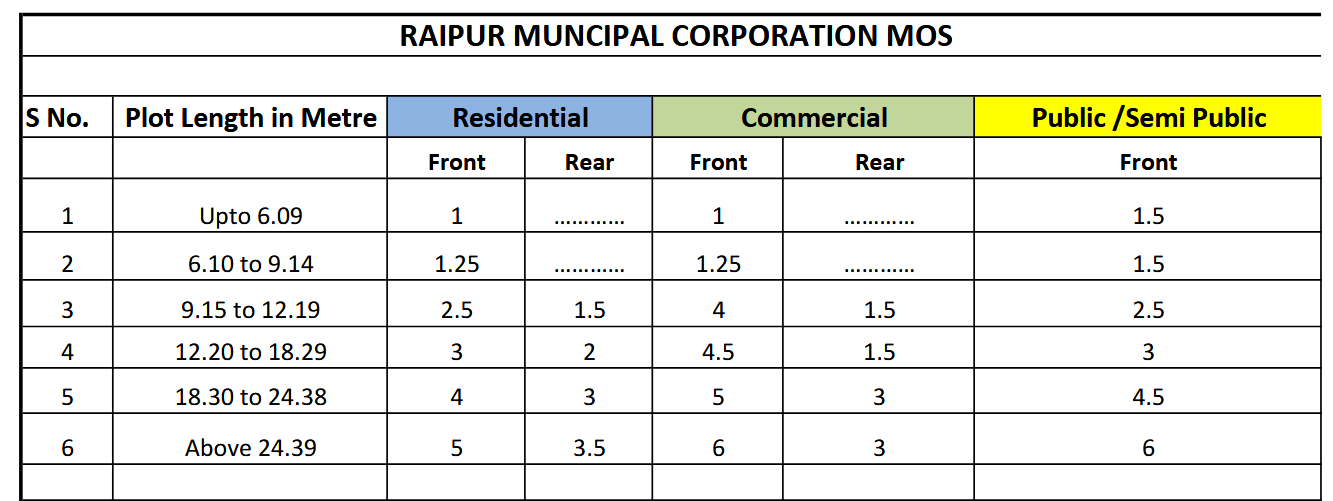
Setback is the open distance maintained between the building and the relevant plot boundary.
Depending on the site and regulations, setbacks may be required at the:
- Front
- Rear
- Left side
- Right side
The required distance can depend on several factors, including plot dimensions, road width, building height, land-use classification, and local development regulations.
Why Are Setbacks Important?
Setbacks are not simply unused pieces of land.
They can provide:
- Natural light
- Air circulation
- Access around the building
- Fire and emergency movement space where applicable
- Privacy from neighbouring properties
- Maintenance access
- Better drainage planning
For this reason, setbacks should be considered while developing the first concept of the house rather than added at the end.
Front Setback
The front portion of the site generally relates to the road-facing side of the property.
The available front open space can influence:
- Main entrance
- Vehicle parking
- Gate position
- Porch
- Landscape area
- Building appearance
The exact requirement should always be verified with the authority applicable to the site.
Side Setbacks
Side open spaces can influence room windows, ventilation, service access, and overall building width.
On narrow plots, even a relatively small change in the permitted side space can have a noticeable effect on the internal floor plan.
Rear Setback
The rear open area can be useful for ventilation, service access, drainage, and maintenance.
Its required size depends on the applicable local regulations.
3. Ground Coverage
Ground coverage refers to the portion of the plot occupied by the building at ground level, as defined by the applicable regulations.
A simple conceptual calculation can be represented as:
Ground Coverage (%) = Ground Floor Building Footprint ÷ Plot Area × 100
For example, if a particular regulation permits only a certain percentage of ground coverage, the designer cannot simply cover the entire plot with rooms.
Ground coverage calculations should be based on the definitions and exclusions specified by the applicable authority because different regulations may treat certain projections or areas differently.
Why Does Ground Coverage Matter?
It controls how much of the site remains open.
This can affect:
- Front parking
- Side access
- Rear open space
- Landscaping
- Light and ventilation
- Rainwater management
- Overall site usability
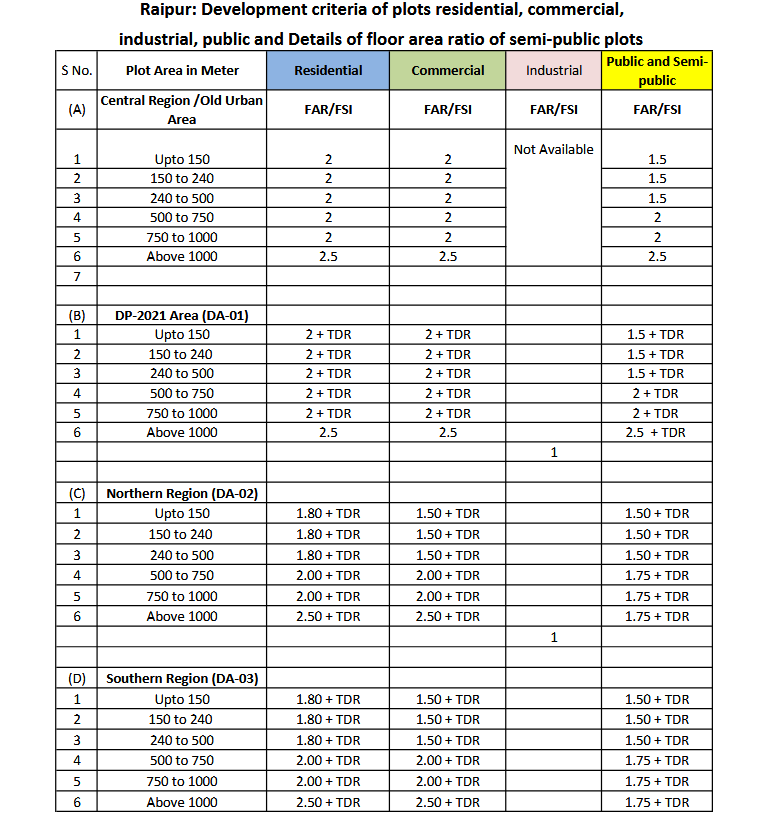
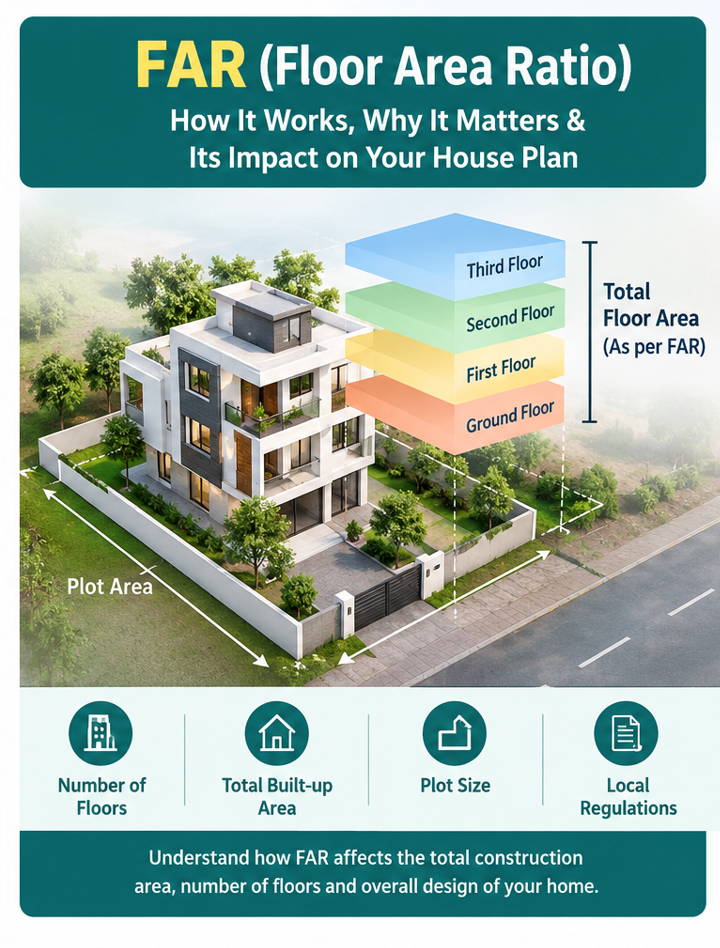
4. FAR or FSI
FAR stands for Floor Area Ratio, while FSI stands for Floor Space Index. The terminology can vary by regulation.
Conceptually:
FAR = Permissible Floor Area ÷ Plot Area
FAR is different from ground coverage.
Ground coverage deals mainly with how much of the plot is occupied at ground level, while FAR relates to the amount of floor area that can be developed across the permitted floors.
For example, a building may occupy a relatively small portion of the plot but have more total floor area because additional floors are constructed, subject to the applicable regulations.
Why Is FAR Important in House Planning?
FAR can influence:
- Number of floors
- Overall built-up area
- Floor-wise planning
- Future expansion
- Building mass
- Feasibility of larger homes
Before designing a multi-storey residence, the designer should establish the applicable FAR/FSI instead of assuming that any desired floor area can be constructed.
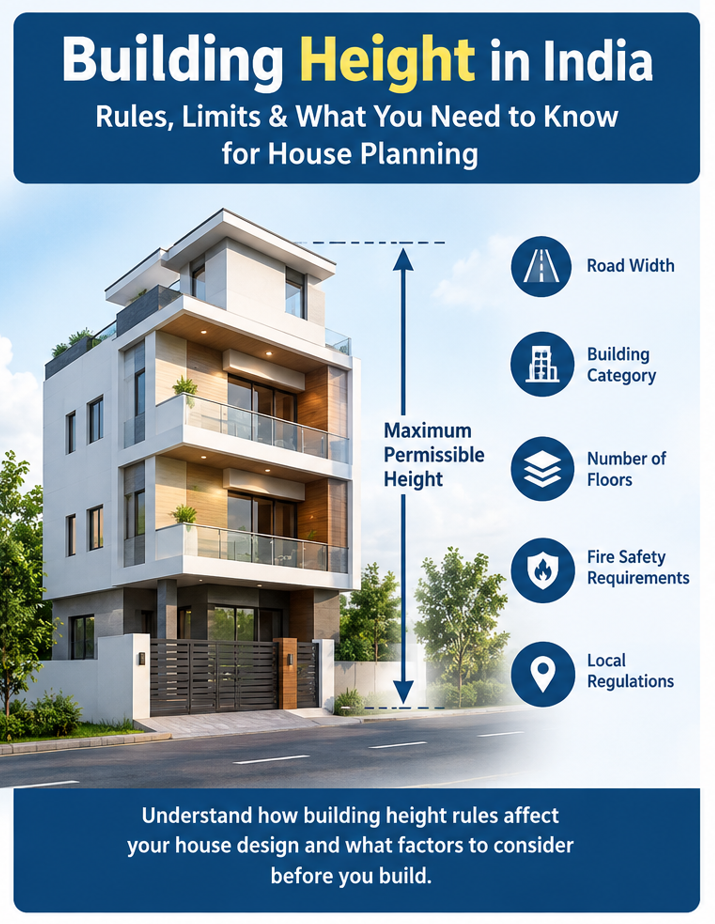
5. Building Height
Building height is another important planning consideration.
The permissible height may be affected by factors such as:
- Road width
- Building category
- Number of floors
- Local development regulations
- Fire-safety requirements
- Special location restrictions
A taller building can also trigger additional requirements that may not apply to a small residential structure.
Therefore, height should be considered together with floor count, staircase planning, services, and structural requirements.
Why Is Height Important?
Building height can influence:
- Floor-to-floor arrangement
- Staircase design
- Roof level
- Water tank location
- Neighbouring buildings
- Street appearance
- Safety requirements
A G+1 house and a much taller multi-storey building cannot automatically be treated under the same planning conditions.
6. Road Width and Building Planning
The road adjoining a plot can have a significant impact on building planning.
Road width may influence development permissions, setbacks, access, parking, and sometimes permissible building height or development intensity.
This is why the architect should verify the actual road condition and official property information instead of relying only on a measurement taken casually at the site.
Important site information can include:
- Road width
- Road alignment
- Plot frontage
- Access location
- Corner-plot condition
- Existing road level
These factors should be considered before finalizing the building footprint.
7. Parking Requirements
Parking is an important part of residential site planning.
A house plan should not treat parking as an afterthought because the vehicle entry can affect the position of the gate, porch, staircase, entrance, and landscaping.
Depending on the applicable local regulations, parking requirements may vary according to:
- Building use
- Dwelling type
- Floor area
- Number of units
- Local development rules
A practical parking layout should consider both the required parking provision and actual vehicle movement.
Good Parking Planning Should Consider
- Vehicle entry
- Gate position
- Turning movement
- Pedestrian access
- Staircase access
- Drainage slope
- Clear movement around parked vehicles
8. Natural Light and Ventilation
A good residential plan should provide adequate natural light and ventilation while complying with applicable regulations.
Room placement, window openings, open spaces and building orientation all contribute to the indoor environment.
Spaces such as bedrooms, living rooms, kitchens and bathrooms may have different ventilation requirements depending on the applicable rules.
Instead of simply filling the plan with rooms, the designer should consider how air and daylight reach each important space.
Why Open Spaces Matter
Open spaces around a building can help:
- Improve daylight
- Allow air movement
- Reduce dependence on artificial lighting
- Provide maintenance access
- Improve the overall comfort of the home
The actual minimum requirements should be checked against the local regulations.
9. Staircase Planning
For houses with more than one floor, the staircase becomes an important planning element.
The staircase should be considered early because it consumes floor area and affects circulation between different levels.
Important considerations can include:
- Stair width
- Riser and tread proportions
- Landing
- Headroom
- Handrail
- Safe movement
- Relationship with rooms
Applicable building regulations should be checked for the specific project.
A staircase that looks acceptable in a conceptual drawing may still need modification when its dimensions are checked against the relevant requirements.
10. Building Use and Land-Use Rules
Not every plot can necessarily be used for every type of building.
Land-use classification can affect whether the proposed development is residential, commercial, mixed-use, institutional, industrial, or another permitted use.
For a residential house, the property should be checked to confirm that the intended use is permitted.
This is especially important when a homeowner wants to combine uses, such as:
- Residence + shop
- Residence + office
- Residence + rental units
- Multiple residential units
The applicable zoning and development regulations should be verified before finalizing such a design.
11. Corner Plots and Irregular Plots
Special site conditions can change the way a building is planned.
A corner plot may have more than one road-facing side, which can influence access, setbacks, parking and building orientation.
Similarly, an irregular plot cannot always be planned using the same approach as a simple rectangular plot.
For an irregular site, the designer should carefully study:
- Actual boundary angles
- Road-facing sides
- Buildable portion
- Setbacks
- Entry location
- Room geometry
- Parking movement
The architectural plan should respond to the actual shape of the site rather than forcing a standard rectangular layout into it.
12. Open Space Around the Building
Open space is an important part of a residential site.
The area outside the building can serve several functions, including:
- Parking
- Landscaping
- Air circulation
- Maintenance
- Service access
- Rainwater management
A well-planned house balances built-up space with usable open areas.
Maximizing construction area is not always the best design solution. The quality and usability of the remaining open space are also important.
13. Rainwater and Drainage Planning
Water management should be considered during site planning.
Roof water and surface runoff need an appropriate drainage strategy according to local conditions.
Depending on the site and applicable requirements, planning may include:
- Rainwater pipes
- Surface drainage
- Recharge arrangements
- Collection systems
- Connection to approved drainage infrastructure
Poorly planned drainage can cause waterlogging and dampness around the building.
Therefore, site levels and drainage should be coordinated with the architectural plan.
14. Fire and Safety Considerations
Safety requirements become increasingly important as building size, height, occupancy and use increase.
For ordinary residential houses, the applicable requirements may differ from those for larger residential, commercial or multi-storey buildings.
Depending on the project, considerations may include:
- Safe staircase access
- Emergency movement
- Fire access
- Exit arrangements
- Fire-fighting provisions
- Electrical safety
Special buildings may require additional approvals or clearances.
The applicable requirements should be confirmed with the relevant authority and qualified professionals.
Building safety involves more than the architectural layout. Fire safety, structural design, building services and other technical considerations may also apply, depending on the project. Readers can consult the National Building Code of India 2016 published by the Bureau of Indian Standards for further information about building standards.
15. Structural Safety Is Different From Planning Approval
One important distinction is that architectural approval and structural design are not the same thing.
A building plan may show:
- Rooms
- Walls
- Doors
- Windows
- Staircases
- Setbacks
- Site information
Structural engineering deals with elements such as:
- Foundations
- Columns
- Beams
- Slabs
- Load transfer
- Reinforcement
- Structural stability
The architectural design and structural design should be coordinated, but one should not be treated as a replacement for the other.
16. Why One Rule Cannot Be Applied to Every City
A common mistake is to search online for one “standard setback” or one “standard FAR” and use it for every property.
Indian building regulations are location-dependent.
The applicable requirements may come from:
- Municipal corporation
- Municipality
- Development authority
- Local planning authority
- Panchayat or other competent authority
- State-level regulations
- Applicable building standards
Therefore, online information should be used for understanding concepts, while the actual project should be checked against the current rules applicable to its location.
Building regulations can vary according to the local authority and location of the property. For a broader understanding of building bye-laws in India, readers can refer to the Model Building Bye-Laws 2016 published by the Government of India. The applicable rules should always be verified with the relevant local authority.
17. A Practical Regulatory Check Before Finalizing a House Plan
Before moving from concept planning to detailed drawings, the following questions should be answered:
Site
- What is the actual plot area?
- What are the plot dimensions?
- Which side faces the road?
- Is the plot regular, corner, or irregular?
- What is the actual road width?
Development Controls
- What setbacks apply?
- What ground coverage is permitted?
- What FAR/FSI applies?
- What building height is permitted?
- Are there special zoning restrictions?
Planning
- Where will the vehicle enter?
- Where will parking be located?
- Is there adequate open space?
- Can rooms receive sufficient daylight and ventilation?
- Is the staircase located efficiently?
Services
- How will rainwater be managed?
- Where will drainage connect?
- Where will water-related services be located?
- Are additional service provisions required?
This preliminary check can save considerable redesign work later.
After checking the applicable building regulations, homeowners should also confirm which supporting documents are required by their local authority. Read our guide to the documents required for building plan approval to understand the documentation requirements.
18. Common Planning Mistakes
Several mistakes occur when building regulations are checked too late.
Mistake 1: Designing the Full Floor Plan First
A detailed plan is prepared before checking setbacks and development limits.
Better approach: Establish the permissible building envelope first.
Mistake 2: Assuming the Entire Plot Is Buildable
The total plot area is treated as available construction area.
Better approach: Separate plot area, permissible footprint and total floor area.
Mistake 3: Copying Rules From Another City
A setback or FAR found online is applied to a different location.
Better approach: Verify the current local regulation.
Mistake 4: Ignoring Road Conditions
Only plot dimensions are considered.
Better approach: Check road width, access and site approach.
Mistake 5: Leaving Parking Until the End
Rooms occupy almost the entire ground floor before parking is considered.
Better approach: Reserve the required parking and vehicle movement space during initial planning.
Mistake 6: Treating Approval and Construction Drawings as the Same
A homeowner assumes that an approval drawing alone is sufficient for construction.
Better approach: Coordinate architectural, structural and service drawings before construction.
19. How Building Regulations Affect a House Plan
Building regulations directly influence architectural decisions.
For example:
Setbacks → influence the building footprint.
Ground coverage → controls ground-level site occupation.
FAR/FSI → influences total permissible floor area.
Height limits → influence vertical development.
Parking rules → influence site access and open space.
Ventilation requirements → influence room openings and planning.
Road conditions → influence entry and development possibilities.
This shows why regulations should be considered part of the design process rather than treated as paperwork after the design is finished.
Once the applicable regulations and buildable area are understood, these requirements need to be reflected in the architectural drawings. Learn more in our guide to residential building submission drawings.
20. Best Approach for Homeowners
A homeowner does not need to memorize every building regulation.
Instead, it is more useful to understand the basic planning concepts and then ask the architect or engineer to verify the project-specific requirements.
Before approving a house design, ask:
- What setbacks are applicable to my property?
- What is the permitted ground coverage?
- What FAR/FSI applies?
- What maximum height is allowed?
- What parking provision is required?
- Are there any special zoning restrictions?
- Are additional permissions required for the proposed building?
- Does the design comply with the current local regulations?
These questions can help identify regulatory issues before construction begins.
Building Regulations vs House Design: What Comes First?
A practical design sequence can be:
Site Information → Applicable Regulations → Buildable Envelope → Concept Plan → Detailed Floor Plan → Elevation & Section → Structural Coordination → Final Documentation
This sequence is more efficient than creating a complete house plan first and checking regulations afterward.
Important Note About Building Rules in India
Building regulations can change over time and may differ significantly between locations.
The information in this article is intended for general educational understanding. It should not be treated as a substitute for the current regulations issued by the authority responsible for the property.
For an actual project, verify the latest applicable requirements and obtain professional advice from a qualified architect, engineer, or other authorized professional before construction.
Conclusion
Building regulations are an important foundation for residential house planning. They influence much more than the approval stage—they can affect the shape, size, height, open spaces, parking, circulation and overall feasibility of a building.
Understanding concepts such as setbacks, ground coverage, FAR/FSI, building height, road access and open space helps homeowners make better decisions before finalizing a house plan.
The most important point is that there is no single set of dimensions that can be applied to every residential plot in India. Local authority requirements and site-specific conditions must always be checked.
A successful house plan therefore combines good architectural planning with regulatory compliance, structural safety and practical site conditions.
Frequently Asked Questions
What are the most important building regulations for a residential house?
Important considerations commonly include setbacks, ground coverage, FAR/FSI, building height, parking, access, open spaces, ventilation and applicable safety requirements.
Is the entire plot area available for construction?
No. The permissible construction area depends on applicable setbacks, ground coverage, FAR/FSI and other development requirements.
Is FAR the same as ground coverage?
No. Ground coverage generally relates to the portion of the plot occupied by the building at ground level, while FAR/FSI relates to the permissible floor area in relation to the plot area.
Do building rules remain the same in every city in India?
No. Requirements can vary according to the local authority, location, land use, road width, plot characteristics and other applicable regulations.
Why are setbacks required around a house?
Setbacks can provide open space for light, ventilation, access, maintenance, drainage and other planning or safety purposes, depending on the applicable rules.
Does road width affect house planning?
It can. Road width may influence development conditions such as access, setbacks, building height or other planning controls depending on the applicable regulations.
Can I design a house first and check building rules later?
It is better to check the important development controls before detailed planning. Early verification can prevent major changes to the design.
Who should verify the building regulations for my property?
A qualified architect or engineer familiar with the local authority requirements can help verify the applicable regulations and coordinate the design accordingly.