
Staircase Section, Plan, and Detailed Design Guide (with Dimensions)
Introduction
It is essential to recognize that a well-designed staircase constitutes a crucial element of the layout of any residential building. While enhancing the architectural aesthetics of the home, it simultaneously ensures a safe means of vertical circulation. In this blog, we will provide a detailed explanation of the complete section, plan, and construction details of a staircase, based on a practical drawing featuring standard dimensions.
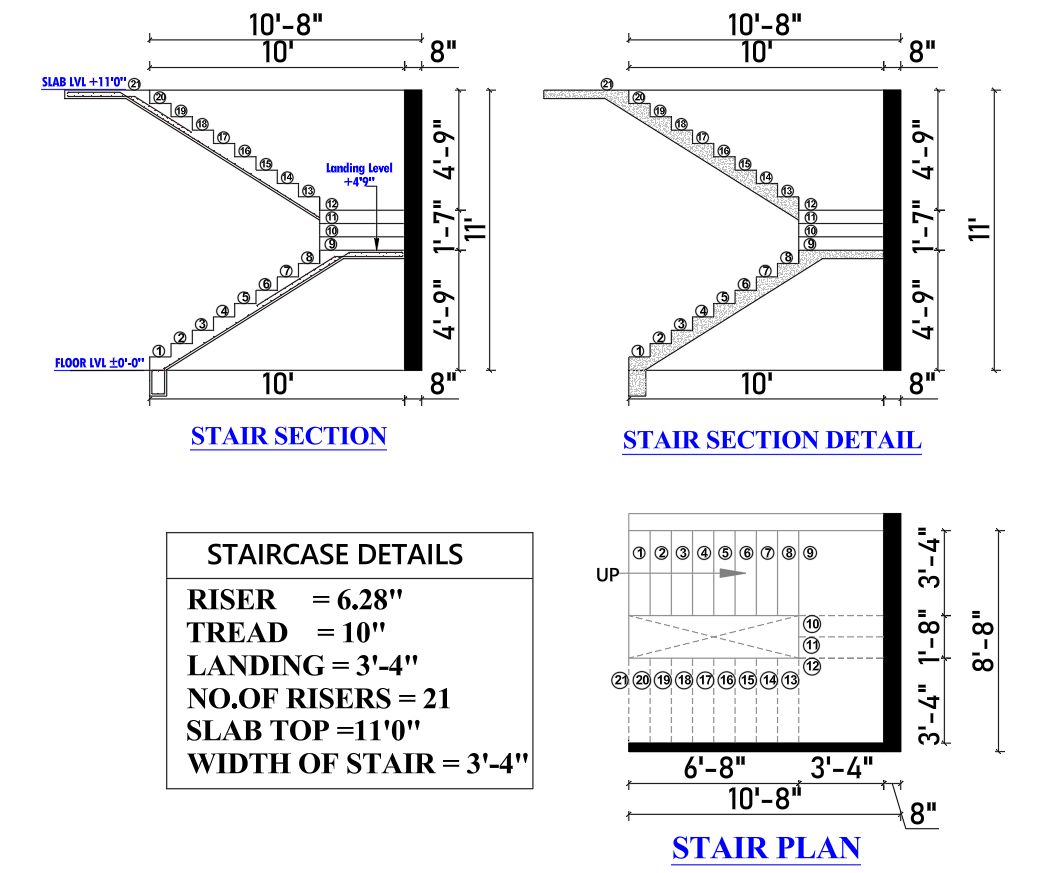
📌 Staircase Design Overview
This is a ‘dog-legged’ staircase, featuring two flights separated by a central landing. It is commonly used in residential buildings due to its space-saving nature and ease of construction.
Key Features:
- Two flights with a central landing
- Comfortable ratio of Rise and Tread
- Suitable for small residential layouts
- Easy to construct and cost-effective
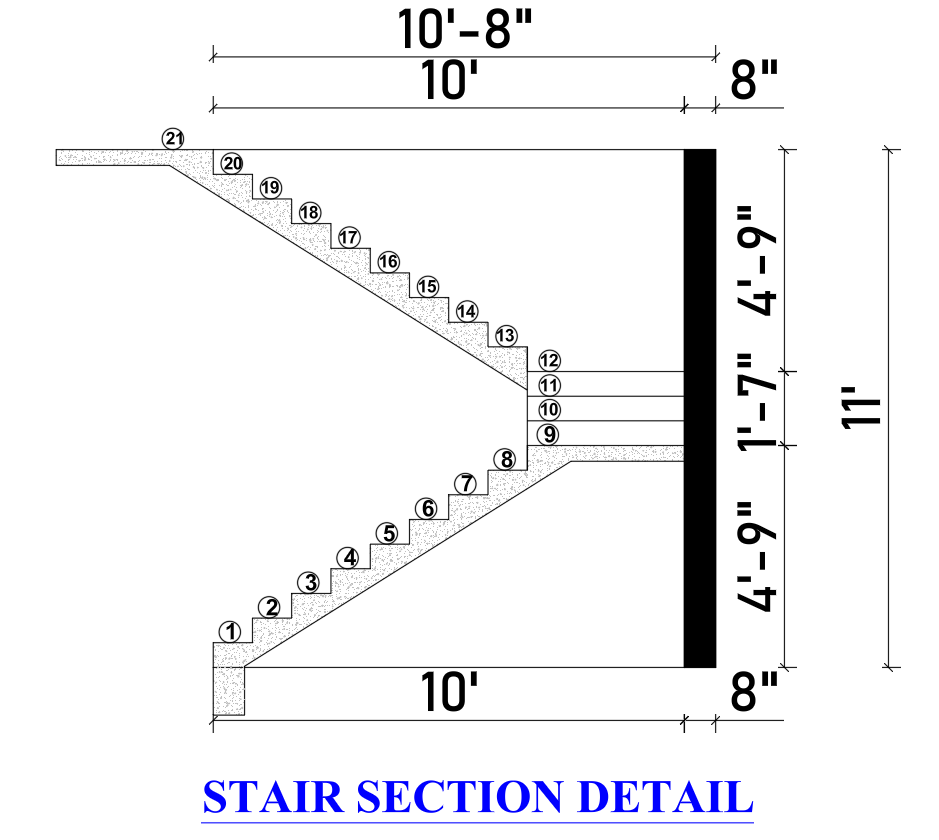
🧱 Staircase Section Explanation
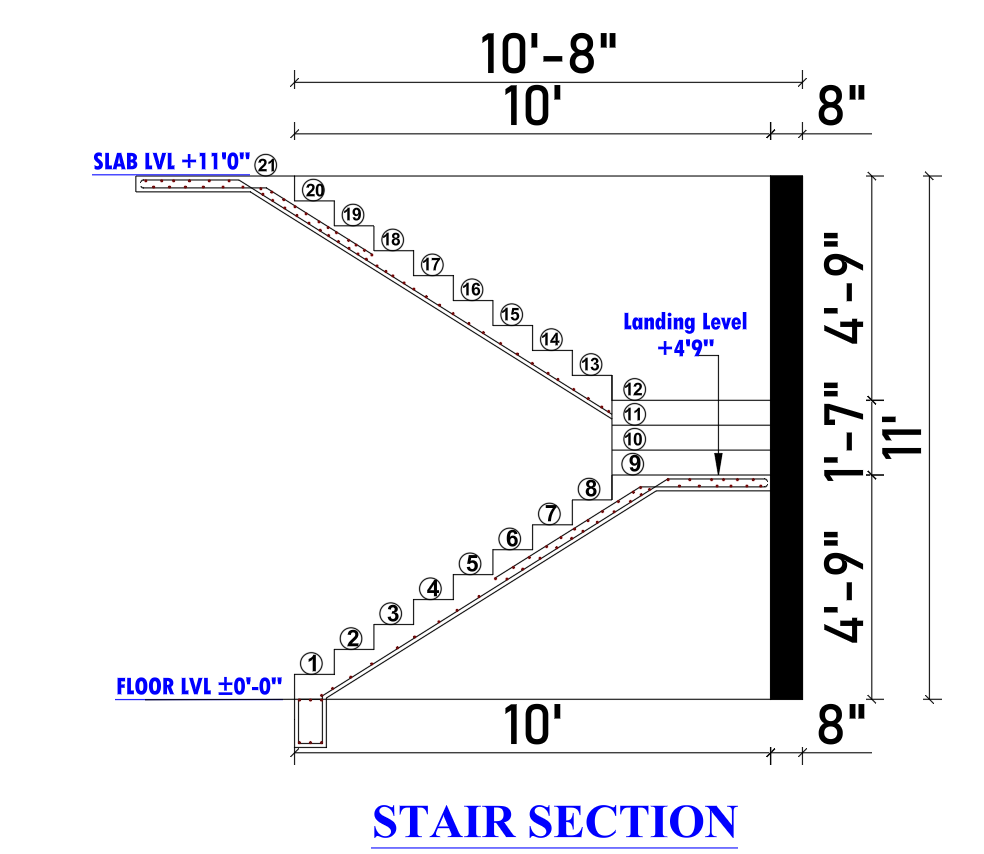
This section illustrates the vertical profile of the staircase, extending from the floor level up to the slab level.
Key Levels:
- Floor Level (±0′-0″)
- Landing Level (+4′-9″)
- Slab Level (+11′-0″)
Flight Division:
- The first flight ascends to the landing.
- The second flight continues up to the slab level.
Key Features:
- Adequate overhead clearance (headroom) has been provided.
- Uniform riser heights ensure safety.
- The landing serves as a resting platform.
Staircase Plan Details
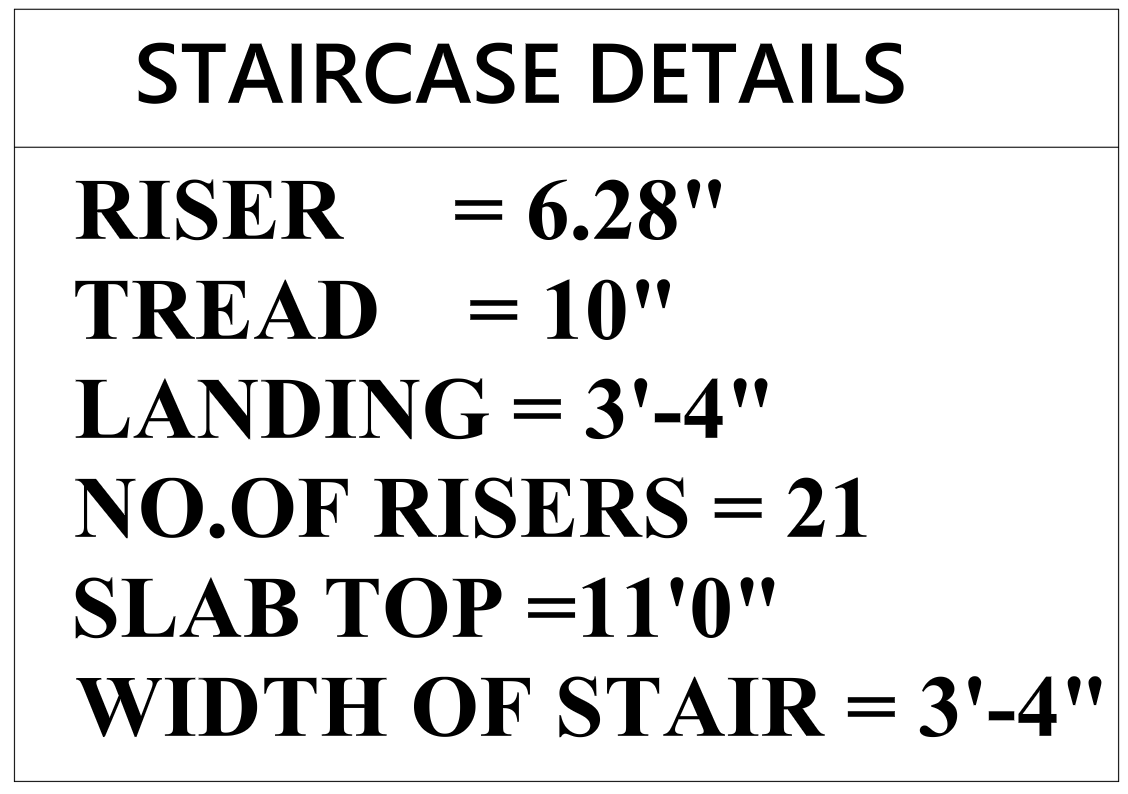
The plan view illustrates the overhead layout of the staircase.
Features:
- The direction of the staircase is clearly marked (UP).
- The steps are numbered from 1 to 21.
- A landing is centrally positioned.
- The width of the staircase is set at 3′-4″.
Space Planning:
- Total horizontal length: 10′-8″
- Efficient utilization of available space
- Suitable for small residential plots
🏗️ Staircase Construction Details
This detailed section covers the following structural components:
Components:
- RCC Waist Slab.
- Stairs finished with plaster or stone cladding.
- Landing slab integrated with the main structure.
- Side wall support for stability.
Construction Tips:
- Ensure proper reinforcement within the waist slab.
- Provide an anti-skid finish on the stair treads.
- Install handrails for safety.
- Maintain a proper slope for water drainage (if the staircase is outdoors)
Standard Formula for Staircase Design
A comfortable staircase adheres to this rule:
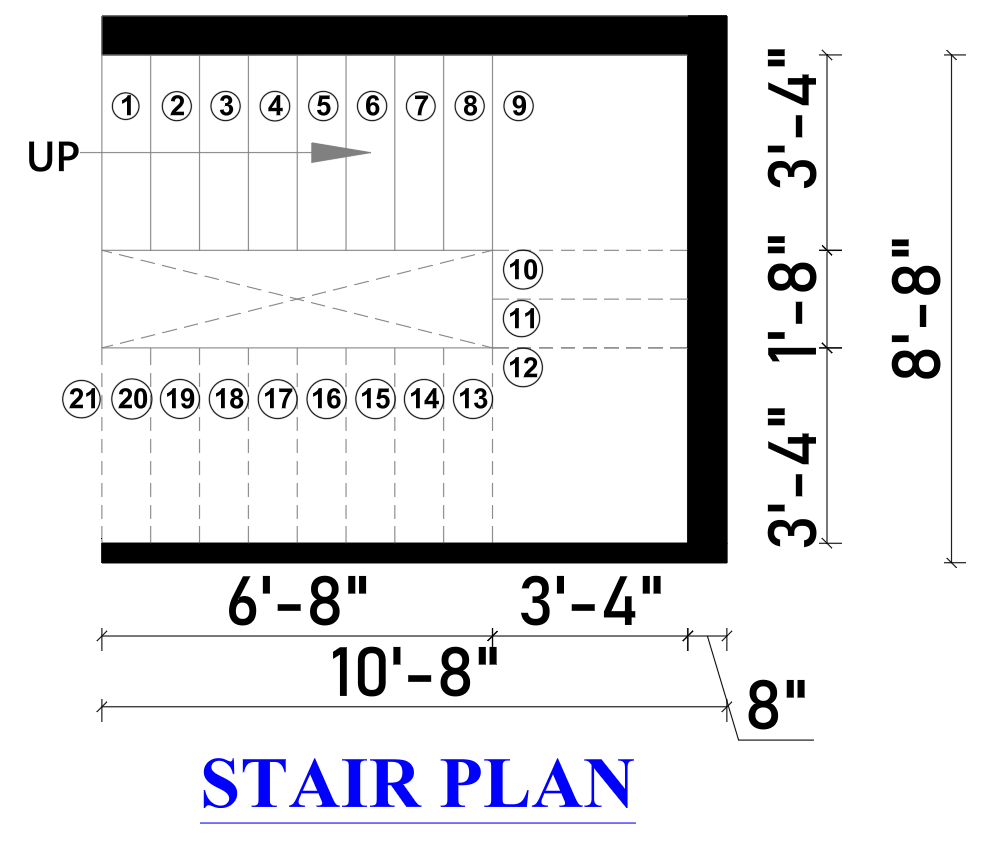
- 2 × Riser + Tread = 24″ to 25″
For this design:
- 2 × 6.28 + 10 ≈ 22.56 (Slightly on the lower side, but suitable for residential use)
Key Design Considerations
1. Safety
- Riser heights must be uniform.
- Non-slip treads.
- Handrail height should be ~ 3 feet
2. Comfort
- Stair width should be appropriate.
- There should be ample space for landing mid-way.
- Transitions between different sections of the staircase should be smooth
3. Efficient Space Utilization
- A “Dog-legged” design saves space.
- No intermediate area goes to waste.
4. Structural Integrity
- Slab thickness must be adequate.
- There should be sufficient reinforcement.
- The supporting side walls must be robust
Advanced Staircase Design Guidelines
1. Ideal Proportions for Comfort
For a comfortable staircase, proportions must follow ergonomic standards:
- Riser: 6″ – 7″
- Tread: 10″ – 11″
- Stair Width: Minimum 3′-0″ (Recommended 3′-6″)
👉 Your design (6.28″ riser & 10″ tread) falls within a safe and usable range, making it suitable for residential use.
2. Staircase Calculation Method (Step-by-Step)
To calculate staircase dimensions:
- Measure total floor height = 11′-0″
- Convert into inches = 132″
- Divide by riser height (6.28″)
- Total risers ≈ 21
👉 Tread count = Risers – 1 = 20
This ensures uniform step distribution.
3. Waist Slab Thickness & Reinforcement
Standard Guidelines:
- Waist slab thickness: 5″ to 6″
- Concrete grade: M20 or higher
- Main reinforcement: Along slope
- Distribution bars: Perpendicular direction
👉 Proper reinforcement ensures durability and load-bearing capacity.
4. Finishing Materials for Stairs
You can enhance durability and aesthetics using:
- Granite (premium finish)
- Marble (luxury look)
- Vitrified tiles (budget-friendly)
- Kota stone (traditional & durable)
👉 Always choose anti-skid finishes for safety.
5. Lighting & Ventilation Design
A good staircase must have proper lighting:
- Natural light through windows
- Artificial lights on walls or ceiling
- Step lights for modern design
👉 Improves safety and visual appeal.
6. Common Mistakes to Avoid
Avoid these errors in staircase design:
- ❌ Unequal riser heights
- ❌ Too steep stairs
- ❌ Insufficient headroom (<7 feet)
- ❌ Narrow landing
- ❌ No handrail
👉 These mistakes can cause safety hazards.
7. Headroom Requirements
- Minimum headroom: 7′-0″
- Recommended: 7′-6″ to 8′-0″
👉 Ensures comfortable movement without obstruction.
8. Vastu Tips for Staircase (Optional Section)
- Staircase should be in South, West, or Southwest
- Avoid Northeast direction
- Clockwise movement is preferred
👉 Useful for clients who follow Vastu principles.
9. Alternative Staircase Types
You can also mention other types for comparison:
- Straight staircase
- L-shaped staircase
- U-shaped staircase
- Spiral staircase
- Open well staircase
👉 Dog-legged staircase is best for compact residential spaces.
10. Cost Estimation (Basic Idea)
Approximate cost factors:
- Material (concrete, steel, finishing)
- Labor charges
- Railing type
👉 Average cost: ₹1,500 – ₹3,000 per sq.ft (varies by location & finish)
11. Staircase Railing Options
Popular railing choices:
- Mild steel railing (budget-friendly)
- Stainless steel railing (modern)
- Glass railing (premium look)
- Wooden railing (classic design)
Why is this staircase design the best choice for homes?
- Fits easily into a small space. (10’-8” in length)
- Easy to construct.
- Cost-effective.
- Comfortable for daily use.
- Suitable for G+1 residential buildings.
Conclusion
Thus, this staircase design strikes an excellent balance between comfort, safety, and efficient space utilization. With precise dimensions—such as a 6.28″ riser and a 10″ tread—it ensures ease of use in most residential settings. The inclusion of an intermediate landing enhances accessibility and safety, making it a practical choice for modern homes.
The ideal riser height is between 6″ to 7″, which ensures comfortable climbing.
The tread should be 10″ to 11″ for residential buildings.
Landing provides resting space and safety, especially in longer staircases.
This is a dog-legged staircase, commonly used in homes.
Minimum recommended width is 3 feet, but 3′-4″ is more comfortable.